

Ian Schiller
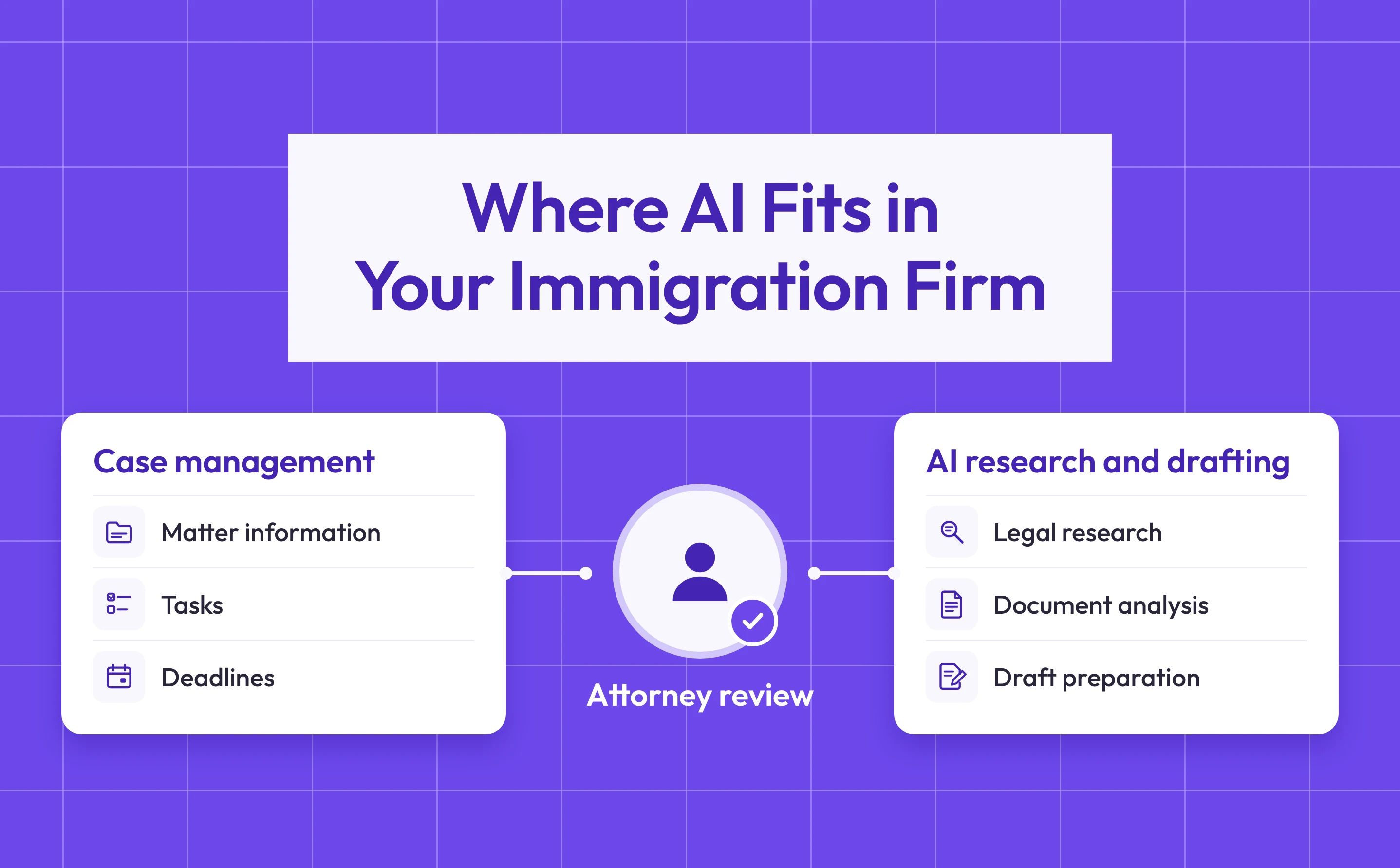
Immigration case management software helps a firm organize matters, client information, tasks, and deadlines. AI legal research and drafting tools help a team work through legal questions, case documents, and written work. A firm evaluating software should test both jobs separately, even when a vendor offers them in the same platform.
Visalaw AI is an immigration intelligence platform for research, document analysis, and drafting. Visalaw AI uses artificial intelligence to perform comprehensive legal research that searches through the world’s largest immigration document database to answer user’s questions with verifiable citations to authoritative sources. Its role in a firm’s software stack is easiest to evaluate through the legal work your team needs to complete. Start with a recurring task, identify the information it requires,and decide where the reviewed result belongs.
This guide offers a practical way to make that decision without turning a research or drafting project into an unnecessary replacement of your firm’s operating systems.
A case management system is usually the place a firm looks for the operational state of a matter. Who owns the next task? Has the client supplied the requested document? What deadline has the team confirmed? The features and coverage vary by provider.
An AI tool that does research and drafting supports the work needed to move that matter forward. What authority addresses the question?Which facts in the record need clarification? How should the first draft explain the evidence? What inconsistencies are there across this case file?
Both tools may hold documents and allow collaboration. Those shared features do not establish that they perform every job equally well.Evaluate the specific activity and the handoff to the next person.
Use this table to assign responsibility within your firm. It is a starting point for evaluating products, rather than a claim that every product in a category provides every listed feature.
The Visalaw AI platform supports immigration legal research, analysis of uploaded documents, and petition and brief drafting. Projects organize research and documents by matter. These capabilities help a team assemble and review the substance of its work.
For example, a team can evaluate whether a document-analysis task produces useful questions for attorney review, or whether a draft gives the attorney a workable starting point. The firm should define how the approved result returns to its matter record.
Visalaw AI has integrations with multiple case management platforms that support document flow between the platforms. If your firm uses an integrated system, ask the demo team to show the exact handoff available in your setup. Confirm what moves, which user initiates it, and where later edits live. Treat those details as requirements to verify before relying on the connection.
Consider an illustrative employment-based matter. The team has a draft support letter, a résumé, and several employer documents. The attorney wants a list of factual discrepancies before reviewing the legal argument.
First, the matter owner identifies the documents and versions to use. A paralegal prepares the approved inputs for the analysis workspace. The task is deliberately narrow: compare stated facts and identify questions. It does not ask the tool to decide the case.
A useful instruction would be:
Compare the uploaded résumé, employer letter, and draft support letter. Identify inconsistent dates, job titles, locations, and descriptions of duties. For each issue, identify the source document and page if available, describe the conflict, and suggest a question for the team. Do not choose which version is correct. If a document or page cannot be read, say so.
The team then checks the flagged items against the originals. If a date differs between two documents, the reviewer records the discrepancy and asks the appropriate person to resolve it. An unanswered question remains open. A polished sentence in an AI response does not resolve the underlying factual conflict.
Finally, the matter owner records the reviewed questions and resulting tasks in the firm’s chosen matter system. Approved documents follow the firm’s version-control process. This can be a manual handoff; the workflow does not depend on an unverified automatic sync.
The deliverable is a checked issue list with an owner for each next step. Our pre-filing evidence and consistency audit guide explores the broader review process.
A combined platform can be useful if it reduces friction across the work your firm actually performs. Ask the vendor to demonstrate one complete task using realistic sample materials, including the review and handoff.
For the example above, look at whether the reviewer can locate the cited document passages, correct the output, and identify the version the attorney should review. Then check how the approved result becomes visible to the person responsible for the matter.
Include the paralegal who prepares the packet and the attorney who reviews it. Their evaluation may reveal work that a short feature demonstration leaves out, such as organizing inputs or reconciling revisions.Our guide to AI adoption in law firms discusses involving the people who will use the system.
Before changing tools, answer these questions:
· Which recurring task are we trying to improve?
· Which system holds the authoritative matter status and deadlines?
· What information enters the AI workspace, and who checks it?
· What output must the attorney review?
· Where does the approved version go?
· What happens when the output is incomplete or the connection fails?
Choose a bounded task with a result the team can evaluate.Preparing a source-linked research summary or comparing a defined set of documents gives the reviewer something concrete to inspect.
For a small pilot, record the time spent preparing inputs,generating output, checking sources, correcting errors, and transferring the result. Compare the total with the existing process. Also record whether the output answered the assigned question and whether the next person could use it.
If a system produces a draft quickly but requires extensive repair, that matters. If it produces a useful issue list but the team loses track of the approved version, improve the handoff before expanding the pilot.
Yes. A firm can evaluate a research or drafting workspace alongside its existing matter system. Define where each task happens and how reviewed work returns to the matter record. Verify any integration you intend to use.
Sharing research or documents does not, by itself, establish deadline tracking or compliance monitoring. Evaluate those functions directly and keep the firm’s established deadline process in place unless a replacement has been tested and approved.
Choose one research, document-review, or drafting task. Ask to see the inputs, output, source inspection, and review process. Bring a description of the workflow and use sample materials appropriate for the demonstration.
Book a Visalaw AI demo focused on one research or drafting task. Use the session to evaluate the work product and decide how it would move through your existing process.


 View all blogs

Subscribe below to receive tips for using AI in immigration law, product updates, and relevant news in immigration.

Memphis, TN